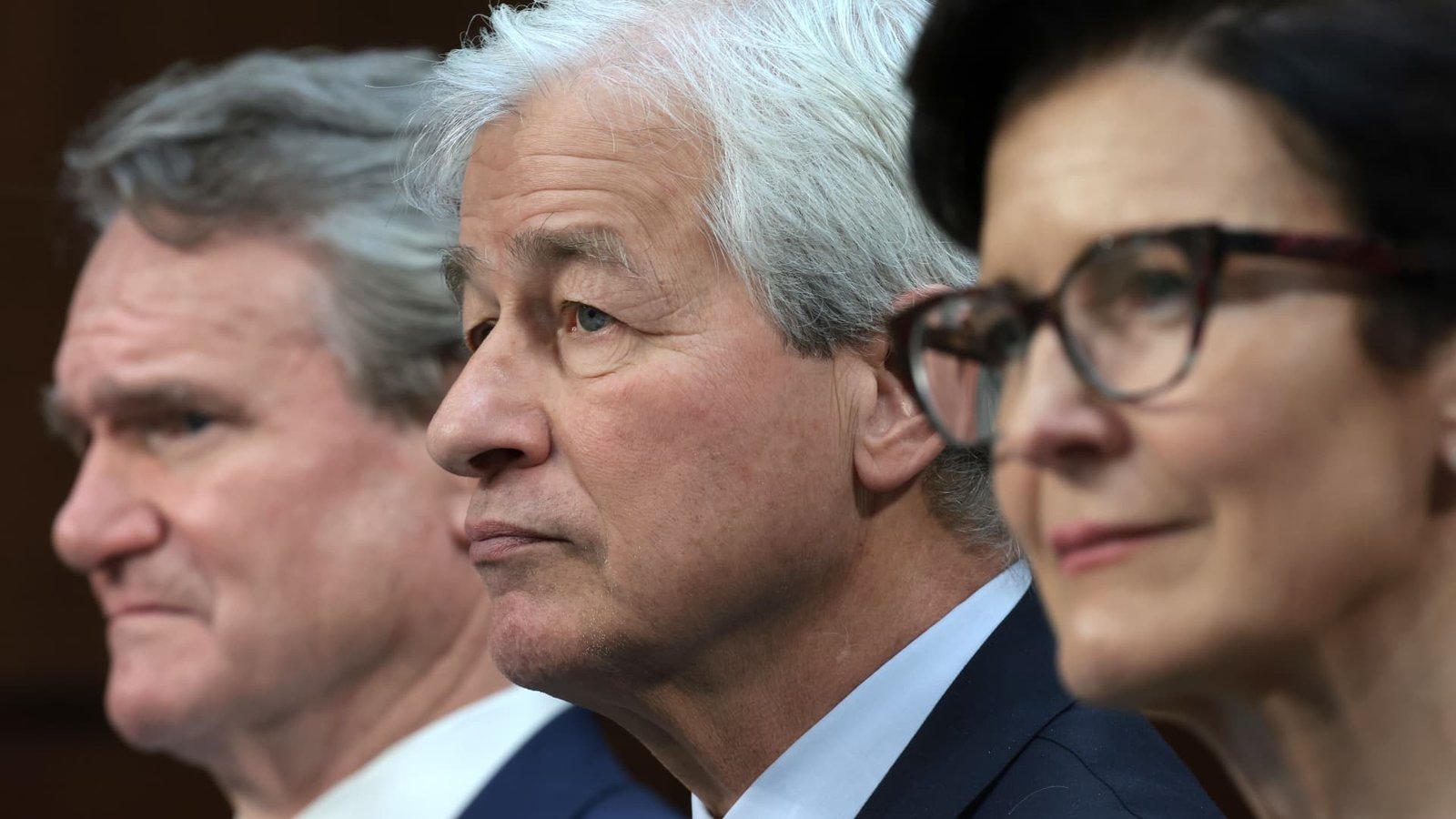
(L-R) Brian Moynihan, Chairman and CEO of Bank of America; Jamie Dimon, Chairman and CEO of JPMorgan Chase; and Jane Fraser, CEO of Citigroup; testify during a Senate Banking Committee hearing at the Hart Senate Office Building on December 06, 2023 in Washington, DC.
Win Mcnamee | Getty Images
Expectations are high that when banks start posting second-quarter results Tuesday, led by JPMorgan Chase and Bank of America, revenue from trading equities and fixed income will approach, or even exceed, the records set earlier this year.
That’s a key part of what veteran analyst Mike Mayo of Wells Fargo calls the “sweet spot” in the financial sector right now. Both of banking’s profit engines — Wall Street and Main Street — are in growth mode at the same time.
The largest U.S. banks are raking in rising fees from helping corporations tap the markets, punctuated by last month’s giant SpaceX IPO, while risk-taking traders are also thriving as geopolitical unrest including the Iran war stokes volatility across asset classes.
“You saw the largest IPO in history, a pace of mergers that’s on track to be a record year, and a broadening out of trading to include equity and fixed income across myriad geographies,” Mayo told CNBC.
The quarter’s big bank earnings come at an unusually favorable moment for the industry. After years of navigating higher interest rates and inflation-fueled recession fears, lenders are benefiting from a rare combination of booming Wall Street activity, resilient consumer credit and a long-awaited pickup in business lending.
“There’s not much more you can ask for,” Mayo said.
The trends, which coincide with the Trump administration’s push to ease banking regulations, have helped financial stocks outperform the broader market for two straight years, Mayo noted. That streak also raises the stakes as investors look for signs the momentum can continue into 2027.
JPMorgan, Bank of America, Citigroup, Wells Fargo and Goldman Sachs are set to post results early Tuesday, with Morgan Stanley reporting Wednesday.
‘Big money maker’
Investment banking revenue for the group could surge 26% from a year ago, while trading revenue could jump 14%, according to KBW analyst Chris McGratty.
Besides the hundreds of millions of dollars in fees that SpaceX paid banks — led by Goldman Sachs and Morgan Stanley — for the IPO itself, the firms garnered fees for raising debt for the newly public company, and also have a shot at managing the wealth of newly minted millionaires and billionaires.
On top of that, Goldman and Morgan Stanley likely reaped so-called soft dollars from the SpaceX initial public offering, according to Jay Ritter, professor emeritus of finance at the University of Florida’s Warrington College of Business.
SpaceX CEO Elon Musk, speaks on a screen remotely from SpaceX headquarters in Starbase, Texas, speaks before the launch of SpaceX’s initial public offering (IPO) at the Nasdaq MarketSite in New York on June 12, 2026.
Adam Jeffery | CNBC
Soft dollars are essentially fees that hedge funds pay investment banks for a slice of an oversubscribed IPO, Ritter said.
“The big money maker for investment banks in IPOs is not the bankers’ fee, but the ability to allocate shares to hedge funds and some active mutual funds that pay soft dollars,” he said.
Meanwhile, trading gains were driven by strength in equities as stock markets climbed during the quarter, as well as heightened activity in fixed income after the Iran conflict sent oil prices, interest rates and currencies swinging, McGratty said.
“Banks are doing a good job these days of capturing the upside of volatility, whereas in previous cycles, they’ve been caught offsides,” McGratty said.
‘Demand is back’
But Mayo contended that the more important development this quarter might be happening away from Wall Street.
The less glamorous business of commercial lending could be turning the corner after years of weakness as banks look to wrest market share from private credit lenders and as the artificial intelligence-fueled spending boom spreads to the rest of the economy, he said.
“Demand is back as companies treat the uncertainty as the new normal and build that new factory, invest in plants and get on with business,” Mayo said.
The trend could benefit regional lenders including Fifth Third because commercial lending represents a larger share of their business than it does for diversified giants like JPMorgan, Mayo said.
Construction of a $16 billion data center developed by Related Digital for Oracle and Open AI, in Saline, Michigan, May 6, 2026.
Jim West | Universal Images Group | Getty Images
Consumer banking also appears healthy. Low unemployment has kept borrowers current on mortgages, auto loans and credit cards, limiting losses.
There are still some risks for the quarter, including potential blowups in the private credit realm, even though that concern has subsided for most banks in the absence of new “cockroaches” emerging. JPMorgan CEO Jamie Dimon warned analysts and investors last year after the collapse of subprime car lender Tricolor Holdings that “when you see one cockroach, there are probably more.”
Another is whether competition over deposits is intensifying, as some players have been forced to pay higher rates to attract and keep savers’ dollars, McGratty said. In an environment where interest rates are steady or rising, that could pressure lender margins.
After two years of market-beating returns, investors are becoming less interested in how strong the last quarter was than whether this unusually favorable backdrop can last.
“We know the quarter’s going to be strong, so I think the question that you ask yourself is around sustainability, right?” McGratty said. “Is it all sustainable?”